
 DE
DE







3 Most Important eCommerce Metrics: AOV, CR, and RPV

When tracking metrics for eCommerce sites, it’s important to understand that metrics simply show symptoms, and different symptoms become visible through different metrics. Tracking these can help you uncover different behavioral trends on your website and take action to improve conversion rate.
To understand how tracking eCommerce metrics can help increase average conversion rate, let us study them by taking an example of company “X” that sells 2 products: one for $1 and the other for $100.
Download Free: A/B Testing Guide
Conversion rate
A conversion is any desirable activity performed by a visitor on your site. From an eCommerce business’ perspective, conversion is visitor performing a checkout.
Conversion rate = number of checkouts/number of unique visitors
If you have an average of 1000 visitors to your site on any given day, and 50 of them become customers, your conversion rate is 5%. Optimizing for conversion rate is converting more visitors into paying and returning customers and help you:
- Convert more of your current visitors, which is more cost-effective than acquiring new visitors
- Generate more revenue at the same cost
Since companies are already paying in some way to acquire traffic to their website — through PPC, SEO, Email, etc — the next step should be to convert more of those visitors into customers. And that’s where conversion rate optimization (CRO) enters.
A German retail company JOSERA achieved a 29% increase in conversion rates through VWO powered optimization.
Let us look at the different metrics with the example of company X which conducted an A/B test on the product page. This is what they discovered:

Average order value
Sometimes it may so happen that revenues can drop because of a dip in conversions among high paying customers. To avoid such scenarios, average order value is what you should be tracking. It’s a direct indicator of what’s actually happening on the profits front.
Average order value(AOV) = total revenue/number of Checkouts
Comparing AOV against Cost Per Order gives a great idea of the profits you make on each order. Consider your Cost Per Order (shipping costs etc.) is $1 and your AOV is $10, giving you a profit of $9 per order. By increasing AOV by 10% to $11, you stand to gain an additional profit of $1 per order.
There are a lot of simple ways to help you bump up the AOV of your eCommerce business:
Set a bar for free shipping
The first tip is to offer free shipping on purchases which are slightly more than your current AOV.

I say ‘slightly’ because free shipping is a tricky subject. You’ll end up increasing the AOV, but the additional shipping charge could reduce the total number of transactions. As per Baymard Institute, the average cart abandonment ratio is nearly 70%. CXL states that lack of free shipping is one of the biggest reasons behind cart abandonment. To make an appropriate decision, you can look to perform an A/B test between completely free shipping and one that is free after a minimum order value. The metrics you should be tracking closely are AOV, the number of sales, revenue, and cart abandonment rate.

Offer discounts on minimum purchase
Are you planning to extend that generous 20% flat discount to clear all your dead stock? Improvise. Tell them they will get the discount on a minimum purchase of $50 or $100 or whatever figure that sufficiently makes up for your lost margins in giving that discount. Give some, take some.
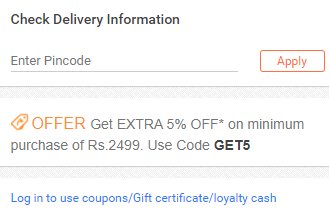
Give limited period offer
Shoppers tend to procrastinate and mull purchase decisions. To continue the ‘special discounts on minimum purchase of 50$’ tip, adding a limited duration to the offer can create a sense of urgency among visitors and encourage them to buy more in one go. For example, ‘Get 40% off on all products’ might motivate the visitor to browse products. But when you say ‘Get 40% off on all products for next 2 days’, it compels them to act right away.

Try volume discounts
Offer discounts on bulk purchases of the same product. Paperstone, an office supplies company, used VWO to launch a bulk discount deal on its website. It ran an A/B test and found the bulk discount deal increased its average order value by 18.94% and revenue by 16.8%. However, remember that you have to determine the right discount value that helps you acquire new customers, and at the same time, doesn’t reduce your profit margins.
Upsell
Upselling, if implemented intelligently, is a great way to increase the value of an order. If a visitor is eyeing that 320GB Windows 7 laptop, just throw in the gleaming photo of that 500GB Windows 8.1 laptop on the side. Simply put, upselling is offering a similar but more expensive variant of the product to the buyer.
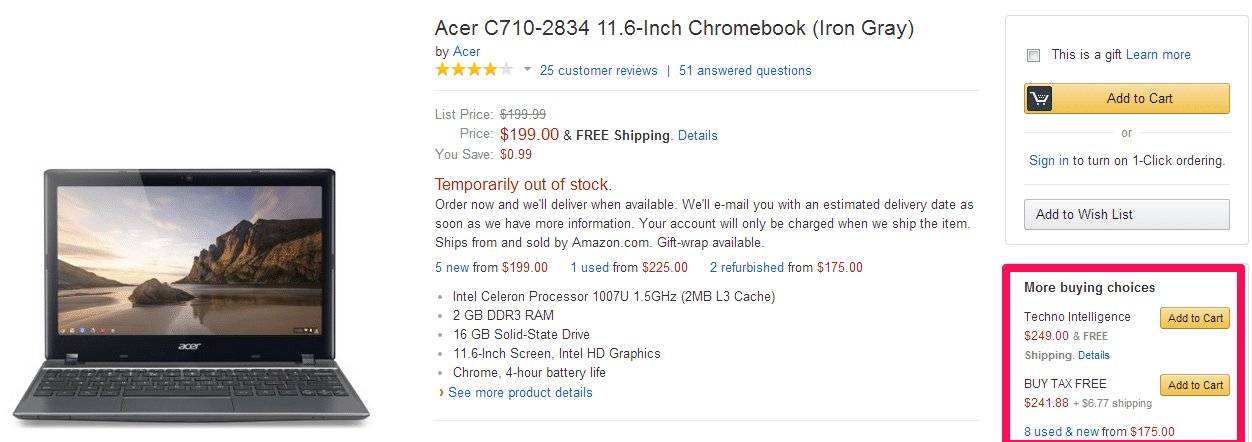
However, there is no point in trying to maximize every transaction, by throwing random products at the visitor. Don’t be like one of those aggressive salespersons trying to sell the entire catalog to someone who hasn’t even made their first purchase.
Cross-sell
Purchasing that 500GB Windows 8.1 laptop? Would you need a laptop bag with it? Or perhaps a USB drive?

This is precisely what cross-selling is known as – soft selling complementary or additional products to your customer base. Studies show that cross-selling is 20 times more effective than upselling even though it has always played second-fiddle to upselling. What you need to keep in mind is that the suggestions need to be relevant. A person buying a laptop will need a laptop bag, not necessarily a DSLR.
Successful upselling and cross-selling can have a huge impact on the fortunes of an eCommerce company. A case in point is American retailer BEAR which increased its revenue by 16% by effectively leveraging cross-selling with the help of VWO.
Offer package deals
A package deal or a combo offer is a cool way of selling two or more related products at a discounted price through your online shop. It’s a convenient way to increase customer spends, move your slow-moving goods, and most importantly grow your average order value. “The Hut” offers a pretty smart discounted price on clothing bundles. Going with the stereotype that most men don’t enjoy shopping, and prefer to get all their stuff quickly, “The Hut’s” offer is well-targeted.

Incentivize the purchase
Always give something to the customer, and they will happily return the favor. Whenever they make a purchase, either offer them a great loyalty program, cash-backs, or something that is redeemable on their next purchase of some minimum order value. For instance, you can give a $5 cashback offer on their next purchase worth $40, or a free gift voucher worth $10 on an order above $60, points for purchasing, and so on. This works in two ways. One is customer satisfaction, and the second is repeat purchases.
Apart from ensuring a second-time visit and fostering customer loyalty, this increases the order value. Customers tend to buy more in order to experience that all-important gratification that comes after having bought something for free (intended oxymoron). It’s easy – see how Paperstone increased AOV by 18.94% using A/B testing.
Download Free: A/B Testing Guide
Revenue per visitor
Again, it may so happen that fewer people end up purchasing on your website as a result of bumping up the minimum order value for free shipping, even though it successfully increased your AOV. Your revenue could take a hit harming your profits while still showing a higher AOV.
If company X tracks AOV alone, it could make the company blind towards conversion rate resulting in a revenue sheet like the one below:

Revenue per visitor (RPV): Revenue per visitor combines both conversions and AOV to give the whole picture. RPV is deceptively simple – it tells you how much revenue each unique visitor is driving. The trick here is to understand RPV from a different perspective.
We already know that,
RPV = total Revenue/total Unique Visitors(checkouts)
So we can rewrite the RPV equation this way: RPV = (AOV x conversions)/total unique visitors
And since (conversions/total Unique Visitors) = conversion rate
RPV = AOV x Conversion rate
What’s the most important thing for any online eCommerce store? Revenue. For revenue, you need traffic. Once you are able to attract traffic, increasing revenue is a two-dimensional process:
- Convert more visitors into paying customers (conversion rate)
- Increase customer-spend per conversion (AOV)
RPV involves both these dimensions leaving no blind spots. If there’s a drop in RPV, it could be due to:
- A sudden increase in number of visitors without any buying intent (drop in conversion rate): Check if there has been any recent marketing, such as email marketing activity that brought a lot of unqualified visitors with low buying intent. Use segmentation to understand what channels are bringing the right traffic.
- Customers are buying less of high-value goods and more of low-value goods (drop in AOV): Consider using a recommendation engine.
For a more detailed analysis, it is better to use funnels to visualize user journeys. Now, after going through all of these metrics and recommendations, Company X may wonder why use only unique visitors (unique and returning) and not total visitors?
Of all the first time visitors to an eCommerce site, most won’t make a purchase. The typical buying cycle involves a visitor first visiting your site to check out the products, leaving to compare prices elsewhere, consulting a few friends, reading reviews and eventually a trip back to your site for the purchase (if at all a purchase decision is made). There could be even more steps involved here.
Using total visitors bloats up your metric denominator considerably, resulting in small figures and giving you less credit than you otherwise deserve.
This is not to say it’s a bad practice, just sub-optimal. (In fact, if for some reason, you are getting many orders from repeat buyers it might even make sense to use total visitors instead of unique visitors.)
Using ‘unique visitors’, on the other hand, paints a real-world picture of what’s happening with your users, who are, of course, unique.
Surely you track some metric(s) that help increase your brand’s conversion rate! But, it is more important to follow-up on tracking by enabling your teams to experiment fast and track the effect of your experimentation on business metrics.
To discover growth opportunities in your conversion rates and to perform high impact experiments, use VWO plan.

FAQs on eCommerce Metrics
Average Order Value is the average amount of revenue your business earns from all the checkout orders.
Average Order Value is calculated as the total revenue divided by the total number of checkouts on the eCommerce store.
Categories: